
Artificial intelligence is no longer a fringe technology in medicine — it is becoming a core component of diagnostics, treatment planning, and patient monitoring. But with greater influence comes greater oversight. Both the United States and the European Union are moving toward stricter, clearer regulations for AI in healthcare, reshaping how startups design, test, and deploy their solutions.
For startups, these regulations may seem like hurdles. In reality, they are gateways to trust, adoption, and market access — provided companies understand them early and integrate compliance into their strategy.
The Regulatory Landscape: A Shift Toward Proactive Oversight
Until recently, many AI medical tools entered the market under existing frameworks for medical devices, with limited AI-specific guidance. That is changing rapidly.
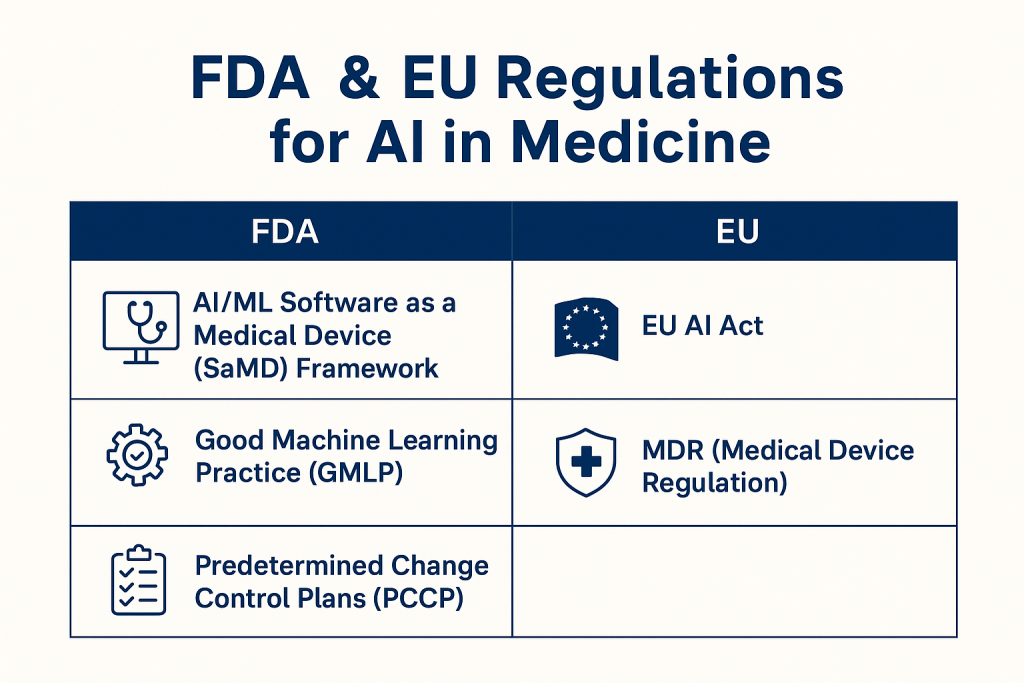
FDA (United States)
- AI/ML Software as a Medical Device (SaMD) Framework
The FDA now recognizes AI and machine learning–based software as a distinct category. Draft guidance outlines how such products should be validated, monitored, and updated after market launch. - Good Machine Learning Practice (GMLP)
Developed in collaboration with other international regulators, GMLP focuses on best practices for data quality, model training, performance evaluation, and transparency. - Predetermined Change Control Plans (PCCP)
Since AI models can evolve after deployment, the FDA is creating pathways for “learning” algorithms to update safely without requiring full reapproval each time.
EU (European Union)
- EU AI Act (Expected Finalization Soon)
The AI Act introduces a risk-based classification system. Medical AI falls under “high-risk” applications, meaning strict requirements for:- Transparency and documentation
- Risk management systems
- Post-market monitoring
- Human oversight mechanisms
- MDR (Medical Device Regulation)
AI tools that qualify as medical devices must comply with MDR, which already mandates rigorous clinical evaluation, quality management systems, and ongoing safety reporting.
What These Standards Mean in Practice
Both the FDA and EU frameworks share core themes:
- Safety and Performance Validation: Demonstrating that AI works consistently across intended populations and scenarios.
- Transparency: Clear documentation of how the AI works, its limitations, and its decision logic.
- Post-Market Surveillance: Continuous monitoring to detect performance drift or unexpected behavior.
- Bias and Equity Considerations: Evidence that the AI performs fairly across demographic groups.
- Human Oversight: AI must support — not replace — qualified healthcare professionals.
For startups, compliance is not simply a legal step at the end of development — it must be embedded into the product lifecycle from day one.
How Startups Can Prepare
1. Integrate Regulatory Thinking Early
Retrofitting compliance into a finished product can be costly and time-consuming. Startups should:
- Map product features to regulatory categories.
- Identify whether the AI will be classified as a medical device in both the U.S. and EU.
- Develop an early regulatory roadmap that accounts for both regions.
2. Prioritize Data Quality and Diversity
Both FDA and EU regulators are emphasizing dataset representativeness. Startups should:
- Collect data from varied sources to cover different demographics, geographies, and equipment types.
- Document the provenance, cleaning processes, and labeling standards for all datasets.
3. Build Explainability into the System
Black-box models are harder to defend before regulators. Incorporating explainable AI (XAI) techniques can:
- Improve clinician adoption.
- Support regulatory transparency requirements.
- Help identify and mitigate bias.
4. Establish a Post-Market Monitoring Plan
From the start, design systems to:
- Log performance metrics in real-world use.
- Detect drift or emerging safety issues.
- Push updates while maintaining compliance with change control plans.
5. Leverage Pre-Submission Consultations
The FDA offers pre-submission meetings, and EU notified bodies can advise early in development. These consultations:
- Clarify classification and documentation needs.
- Identify potential obstacles before formal submission.
6. Adopt a Global Mindset
Even if a startup plans to launch in only one region initially, aligning with both FDA and EU standards from the outset:
- Simplifies future expansion.
- Builds investor confidence.
- Reduces risk of re-engineering for new markets.
Opportunities Hidden in Regulation
While regulations may feel like a barrier, they also:
- Build Credibility: Products with FDA clearance or CE marking gain immediate trust with hospitals, insurers, and patients.
- Differentiate from Competitors: Many AI startups overlook compliance until it’s too late — early adopters of robust regulatory strategies will stand out.
- Encourage Better Products: Regulatory rigor often drives higher-quality, safer, and more clinically useful AI tools.
The Road Ahead
The coming years will see tighter integration between AI development and regulatory science. Startups that treat compliance as an ongoing partnership with regulators — rather than a final checkbox — will have a competitive advantage.
As AI in medicine matures, regulations will likely evolve toward:
- Real-time oversight of adaptive algorithms.
- Standardized AI performance metrics.
- Global harmonization of approval processes.
Conclusion
The FDA and EU are signaling a clear future: AI in healthcare must be safe, transparent, fair, and accountable. For startups, that means building not only innovative technology but also a compliance strategy from day one.
Those who embrace this shift will not only meet the legal bar but also earn the trust of clinicians, patients, and investors — positioning themselves as leaders in the next era of medical innovation.
Leave a Reply