
Artificial intelligence is rapidly becoming an influential voice in healthcare — interpreting scans, predicting disease risk, recommending treatments, and even advising on lifestyle changes. Yet no matter how accurate these systems become, their clinical value depends on one critical factor: whether patients trust and act on their recommendations.
Trust is not automatic. While AI can offer evidence-based suggestions in seconds, many patients still hesitate to accept medical advice generated by algorithms. Building trust in AI decisions is not simply a technical challenge — it’s a human one.
Why Trust Matters in AI-Driven Healthcare
In healthcare, the gap between knowing the right course of action and following it can be wide. Even the most advanced AI system cannot improve health outcomes if patients doubt its credibility or feel disconnected from its reasoning.
Lack of trust can manifest in several ways:
- Patients ignoring AI-driven alerts or notifications.
- Reluctance to consent to AI-assisted diagnostic procedures.
- Preference for human clinician opinions, even when AI recommendations are statistically superior.
- Skepticism toward AI in sensitive health domains, such as mental health counseling or cancer risk prediction.
The question is: What must happen for patients to not only trust AI but act on its advice?
Key Factors Influencing Patient Trust in AI
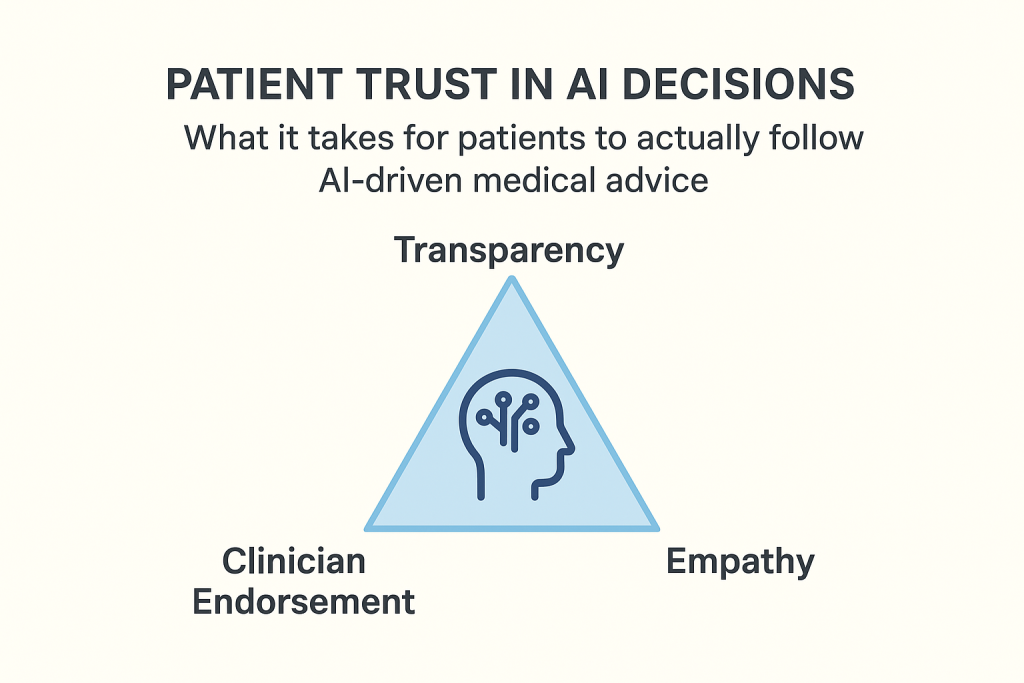
1. Transparency and Explainability
Patients are more likely to trust AI when they understand how it reached its conclusion. This doesn’t mean showing complex algorithms — it means offering clear, patient-friendly explanations:
- “Your chest X-ray shows signs of pneumonia, and this is supported by patterns also seen in confirmed pneumonia cases.”
- “The system compared your lab results with thousands of similar cases and identified this treatment as the most effective.”
The more an AI feels like it’s reasoning with the patient rather than dictating to them, the higher the trust.
2. Clinician Endorsement
Research consistently shows that patients trust AI advice far more when it is presented or validated by a human clinician. The human element adds emotional reassurance and contextualizes recommendations within the patient’s personal medical history.
3. Proven Track Record
Public confidence grows when AI systems are backed by peer-reviewed studies, regulatory approvals, and real-world success stories. Patients want to know: “Has this worked for people like me?”
4. Consistency and Reliability
If an AI system frequently changes its recommendations or gives contradictory advice, trust erodes quickly. Stability, even as the system learns and improves, is essential.
5. Empathy in Communication
Patients do not only evaluate the accuracy of advice; they also respond to how it’s delivered. AI-generated advice should use respectful, empathetic language that acknowledges patient concerns, rather than issuing cold, technical statements.
Barriers to Patient Trust
While AI holds immense promise, several common barriers still limit patient acceptance:
- Fear of Dehumanization: Patients worry that AI will replace the compassionate, personalized care they value in human clinicians.
- Bias Concerns: Awareness of algorithmic bias in other industries makes patients question whether medical AI will treat all demographics equally.
- Data Privacy Issues: Patients may hesitate to follow AI advice if they believe their personal health information could be misused.
- Perceived Lack of Accountability: “If the AI is wrong, who’s responsible?” remains an unresolved question for many.
Building a Trustworthy AI-Patient Relationship
To close the gap between AI capabilities and patient adoption, healthcare providers and developers should focus on the following strategies:
1. Human-AI Collaboration as the Default
AI advice should be positioned as augmenting — not replacing — clinician expertise. Presenting AI as a “second opinion” reinforces its role as a support tool rather than an authority figure.
2. Personalization of Recommendations
Generic advice breeds skepticism. AI systems that tailor recommendations to an individual’s unique medical history, lifestyle, and preferences are far more persuasive.
3. Education and Health Literacy
Patients need to understand the basics of how medical AI works. Short educational materials, clinician-led workshops, or interactive apps can demystify AI and reduce fear.
4. Visible Accountability
Every AI recommendation should come with a clear statement of responsibility, such as:
“This recommendation has been reviewed and approved by your care team.”
5. Feedback Loops
Allow patients to give feedback on AI recommendations and see how their input shapes future advice. This fosters a sense of partnership and agency.
The Role of Cultural and Social Factors
Trust is not built in isolation — it’s shaped by cultural attitudes toward technology, previous healthcare experiences, and even media coverage of AI. In communities with low trust in institutions, AI adoption may face greater resistance, requiring targeted outreach and community engagement.
The Future: Trust as a Measurable Metric
In the near future, healthcare organizations may begin measuring “AI trust scores” — indicators of how much patients rely on and follow AI advice. These metrics could be as critical to an AI system’s success as its diagnostic accuracy.
Advancements in explainable AI, combined with robust clinical validation, will make it possible for AI tools to not only be accurate but also believable. When patients feel confident that AI sees them as more than just data points, adoption will accelerate.
Conclusion
The science behind AI medical advice can be flawless, but without patient trust, it is functionally powerless. Trust requires a blend of transparency, human endorsement, empathy, and consistent performance.
AI in healthcare will only reach its full potential when patients view it not as a mysterious algorithm, but as a reliable partner in their care journey — one that earns trust through clarity, collaboration, and proven results.
Leave a Reply